Quelques jolies bourgades, aux maisons souvent peintes de couleurs vives, caractérisent le paysage madelinot. J’ai voyagé aux 4 coins du monde et jamais je n’aurais pensé être aussi émerveillée par ces paysages si près de chez nous, nos Îles, sur notre territoire québécois.
Fruits de mer, homard et ses produits dérivés, bière de micro-brasserie, hareng fumé… la gastronomie insulaire des Îles impressionne! Par ailleurs, la terrasse de la microbrasserie À L’Abri de la Tempête de l’Étang du Nord ne donne pas sa place! Elle propose une vue à 180 degrés sur la plaine environnante et la plage Le Corfu, prisée par les Madelinots et très jolie au coucher du soleil.

Je n’y ai séjourné que quelques jours mais la richesse et l’exotisme de ces Îles m’ont imprégnée à tout jamais. En commençant par l’île d’Entrée et son ciel mauve percutant, l’escalade de la butte ronde et de la butte du vent, la visite d’artistes et d’artisans de vêtement écologique, de peinture, de fromage et de bière locale, l’écoute de l’accent unique des Madelinots (et leur charme!), la visite du site historique de la Grave, les dunes de sable, les phares, les grottes méconnues, les falaises de grès rouge, les criques, les oiseaux marins, le bleu des vagues, les petites maisons colorées dans la prairie, la gastronomie et les produits locaux, et j’en passe, comment y choisir un seul coup de cœur? Après toutes ces expériences vécues en seulement 4 petits jours, qu’est-ce que les Îles pouvaient bien m’offrir de plus?
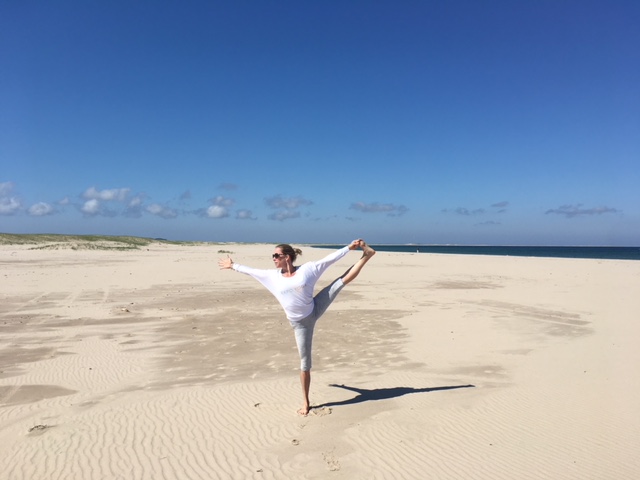
Je me suis finalement échouée sur la plage de la Grande Échourie. Un site complètement sauvage où la présence humaine se fait rare, où la nature semble encore avoir le dessus. Cette plage à perte de vue avec ses 8 km de sable chaud est parmi les plus belles plages du monde selon les Madelinots. Pas besoin de preuve à l’appui, je suis convaincue! Cette majestueuse plage offre aussi les eaux les plus chaudes de l’archipel. À marée basse, on peut y observer des phoques qui jouent dans l’eau ou visiter quelques grottes. Si la mer est calme, on peut s’y baigner sans crainte. Si elle est agitée, mieux vaut profiter du soleil! On peut marcher sur le large littoral des heures sans rochers, sans algues, sans obstacles. Le calme, le vrai… l’odeur de la mer et le sable doré fin et chaud, simplement.
Que demander de plus? Peut-être y pratiquer une séance de yoga!
Joignez-vous à moi à la retraite des Îles pour une expérience riche et unique. Un séjour où tous les éléments de la nature et vos sens s’éveilleront…une retraite pour vous connecter, nourrir et inspirer.
Mélanie
]]>
Après plusieurs années à recevoir les trucs de mes amies (et références de mon chum!), voici 5 petits trucs que je vous propose de faire ensemble pour le prochain mois :
1- Donnez ou recyclez deux items (pas de vêtement!) par jour pendant 30 jours (60 items en tout!)
2- Prenez 5 minutes par jour pour désencombrer un endroit précis pendant une semaine (pharmacie, coffre à gants de voiture, sacs à main)
3- Prenez une journée pour nettoyer votre garde-robe :
- Sortez tout ce qui est dans votre garde-robe
- Catégorisez tout ce que vous avez sorti (chaussures, pantalons, accessoires…)
- Triez par « donner », « peut-être » et « conserver »
- Retriez les « peut-être » en remettant au minimum 50% dans la catégorie « donner »
- Préparez les sacs « donner » et offrez-les à un organisme qui en a bien besoin
- Remettez les éléments « conserver » par catégorie dans votre garde-robe
- Appréciez le résultat!
4- Choisissez une armoire, étagère ou tiroir (seulement une partie d’un meuble/endroit) et prenez 10 minutes pour y sélectionner tout ce qui est non-essentiel et retirez-le, donnez-le!
5- Choisissez un week-end dédié au decluttering et mettez-le à votre agenda. Priorisez les pièces à désencombrer, préparez des sacs et des boîtes, triez ce qui est à donner ou à recycler. Replacez le tout pour que la pièce soit propre, libre et que vous vous y sentiez zen! Répétez l’exercice dans les autres pièces. 
Vous pouvez choisir un ou plusieurs éléments de cette liste, l’important c’est de vous y commettre et de n’avoir aucune raison acceptable qui vous empêche de le faire!
Bon decluterring!
Namaste,
Katrina xxx
]]>Whether you are gazing externally or internally, you eventually begin to visually blank out other objects. As you do so, sushumna occurs, where by your brain becomes isolated from the usual memories, thoughts and feelings that come and go naturally. Additionally, trataka is said to aid vision by keeping eyes healthy, relieve depression and insomnia, reduce allergies and fatigue, and enhance energy levels. Lastly, practicing trataka can also enhance intuition and open up access to a higher state of consciousness.
Bahiranga: external gazing
Most people use a candle flame as a focus point, but you can concentrate on whatever you want. A fountain, the sunset, a flower or a leaf can be used. A plain object may be easier to apply your attention to than one with great detail. Find a central point on which to concentrate your vision. If you are looking at a candle flame, your focal point could be the wick inside the flame because it won’t distract you by flickering.
Make sure you are sitting in a comfortable, meditative pose and won’t be disturbed as you gaze at your focal point. Thoughts may arise initially, but allow them to pass without paying them attention. Don’t mentally force them to leave, just see them in the same way you would notice passing strangers, if you were sitting on a park bench.
Antaranga: internal gazing
When you are ready, begin antaranga, also known as internal gazing. Close your eyes and notice the after image, or memory of the external image, in your mind’s eye. Keep watching it with a steady, fixed gaze, applying attention to the central point. If your vision wanders, bring it back to the middle of the image again.
Alternatively, you may choose to begin meditation with antaranga, going straight into internal attention instead of gazing at an external point. Perhaps you will begin with an imaginary picture of a candle, a star, the moon, or a bright white light that glows in the area of your third eye, just inside your head between your eyebrows. The aim is to become one with a chosen focal point, so you don’t recognize any difference between it and you. At such a time, you can travel beyond your ego.

This article was originally published on Ipnos’ blog, associated partner of Expo Yoga 2018.
]]>Defining dream vs reality.
According to the ancient practice of dream yoga, we can dream during the day when we usually imagine ourselves awake. When you daydream, while carrying out your daily tasks, you’re not sleeping, but you’re not really awake either.
While some believe that the world, the entire universe and beyond, are simply an illusion created as a matrix of thought-forms, based on the law of attraction, we magnetize what we focus on and our thoughts accumulate to form our experiences.
Now that you have begun considering the possibility that wakefulness might not be all that it seems, think about whether a dreaming state is really non-wakefulness at times. After all, people report that they are fully aware during lucid dreaming. In fact, some claim that they feel more awake during lucid dreaming than during the day when they are not sleeping.
Questioning what reality in this manner can help greater awareness to flow. Additionally, you can begin detaching from the thought that wakefulness during the day and night are substantially different. In short, believing that you can move about with purpose in your dreams is the key to achieving your goal.
Become a lucid dreamer.
As you prepare for bedtime and just before you close your eyes to sleep, tell yourself that you are going to have a dream in which you are fully conscious. You can also remind yourself of this intention during the day in order to prepare your mind for a dream yoga experience. If you do not experience lucid dreaming at first, do not despair. Increase your intention to master your dream state by visualizing yourself being in a lucid dream when you are in a relaxed, dreamy state.
Whether you’re imagining that you’re having a lucid dream, or whether you actually experience one, start controlling actions and to make things happen, rather than drifting along the dream and waiting for something to happen. For instance, turn on a tap and see and feel water coming out of it, and practice opening doors, walking up and down steps, and running. When you’ve mastered purposeful movement in your dreams, recognize the powers this dream state gives you. For example, you can fly, walk through walls and teleport. Use your power and enjoy lucid dreaming.
Travel to other planes.
Once you have harnessed your dream powers, develop the intention to meet enlightened beings while you sleep. Ask that they bestow you with important knowledge and help your growth toward higher consciousness. You can also intend to travel to different planets and planes of existence, and take on the body of a creature such as an eagle or bear, experiencing what it is like to be them. Ultimately, dream yoga can help you recognize your limitations and blockages to growth and provide opportunities to overcome them. You can gain confidence, and even heal from your past when you become proficient at this ancient art.
This article was originally published on Ipnos’ blog, associated partner of Expo Yoga 2018.
]]>What type of sensations might you experience?
You might feel a sense of being at one with the universe, which in a way, is the opposite of concentrating on your body. You may feel as though your consciousness doesn’t reside in a physical form.
You might feel lightheaded, or experience a tingling sensation. Some people report having involuntary movements, such as a hand rising, while others say that their body twitches.
What causes sensations during meditation?
The jury is out regarding why some people experience sensations while they meditate. According to some meditation teachers, the phenomenon are caused by the release of stress as part of a healing process that taking place. Others say that sensations occur simply because the brain is relaxed. What we do know, is that people tend to become more aware of physical sensations while they meditate.
Instead of focusing on the outside world as is typically done, meditations brings the attention to our inner-world, including our body. By concentrating on the process of breathing, on your heart or perhaps, on your chakra points, your attention will be directed to the way your body feels. You might become aware of sensations that regularly occur, but that you don’t usually notice when not meditating.
What should you do when you have sensations?
If you experience sensations, you can visualize yourself breathing into the areas of your body in question. Alternatively, you can just allow them to happen without paying them any more or less attention.
It can be normal to discover that you become aware of your body and of specific sensations while you meditate. Instead of letting them worry you, you can make them part of your practice purposefully, or allow them to simply happen.
This article was originally published on Ipnos’ blog, associated partner of Expo Yoga 2018.
]]>D’abord, le terme vient du pluriel du nom latin unda, qui désigne de l’eau, en particulier de l’eau en déplacement comme une vague.
J’ai eu un coup de cœur pour la pratique du SUP Yoga à l’été 2010. Ce fut pour moi la combinaison parfaite entre une pratique ancestrale, mon amour pour l’eau et les sports nautiques et mon besoin de connecter aux éléments de la nature!
Après plusieurs années d’enseignement du SUP Yoga et également l’enseignement de plusieurs formations sur l’eau, je cherchais une alternative à ma pratique intérieure lors de la saison froide. C’est de cette façon que l’idée à fait son chemin et que nous, mon mari Julien et moi-même, avons développé un objet qui pouvait répondre 100% à mes besoins : une plateforme de travail assez grande pour pouvoir effectuer mes postures de yoga et un degré de bascule simulant le mouvement de l’eau. La planche UNDA était née. De plus, avoir un objet fait de façon éco-responsable et à la main était un must!
J’ai donc transféré mes séquences de SUP Yoga sur cette planche. Bien que les effets positifs de l’eau n’y sont pas, j’ai tout de même constaté que le corps reconnaît certaines sensations ressenties sur une planche à pagaie. Et pour ceux et celles qui ont déjà pratiqué le SUP Yoga, les images en mémoires se réveillent au moindre mouvement sur la planche en bois… C’est comme reconnecter avec une pratique estivale, mais à l’intérieur.
Sachant que le corps n’est jamais totalement statique et immobile, le fait de pratiquer l’enchaînement précis de certains asanas sur une surface instable permet au corps de travailler différemment que sur une surface stable.
Par exemple, les chevilles étant davantage sollicitées, les participants prennent conscience de l’importance d’engager l’arche des pieds, tel que nous le répétons régulièrement dans les cours de yoga «classique».
De plus, on remarque parfois une certaine forme de pilote automatique souvent inconsciente dans la pratique du yoga. Or, sur la planche, c’est impossible car si notre attention et notre présence ne sont pas de paire avec l’exécution de la posture ou de la transition vers une autre posture, on perd assurément l’équilibre. Et c’est ce qui frappe souvent les participants! Aussi, cette pratique se fait à un rythme un peu plus lent, ce qui permet de s’assurer d’être bien enraciné dans la posture finale. Parfois, l’alignement peut varier légèrement afin d’avoir une meilleure stabilité.
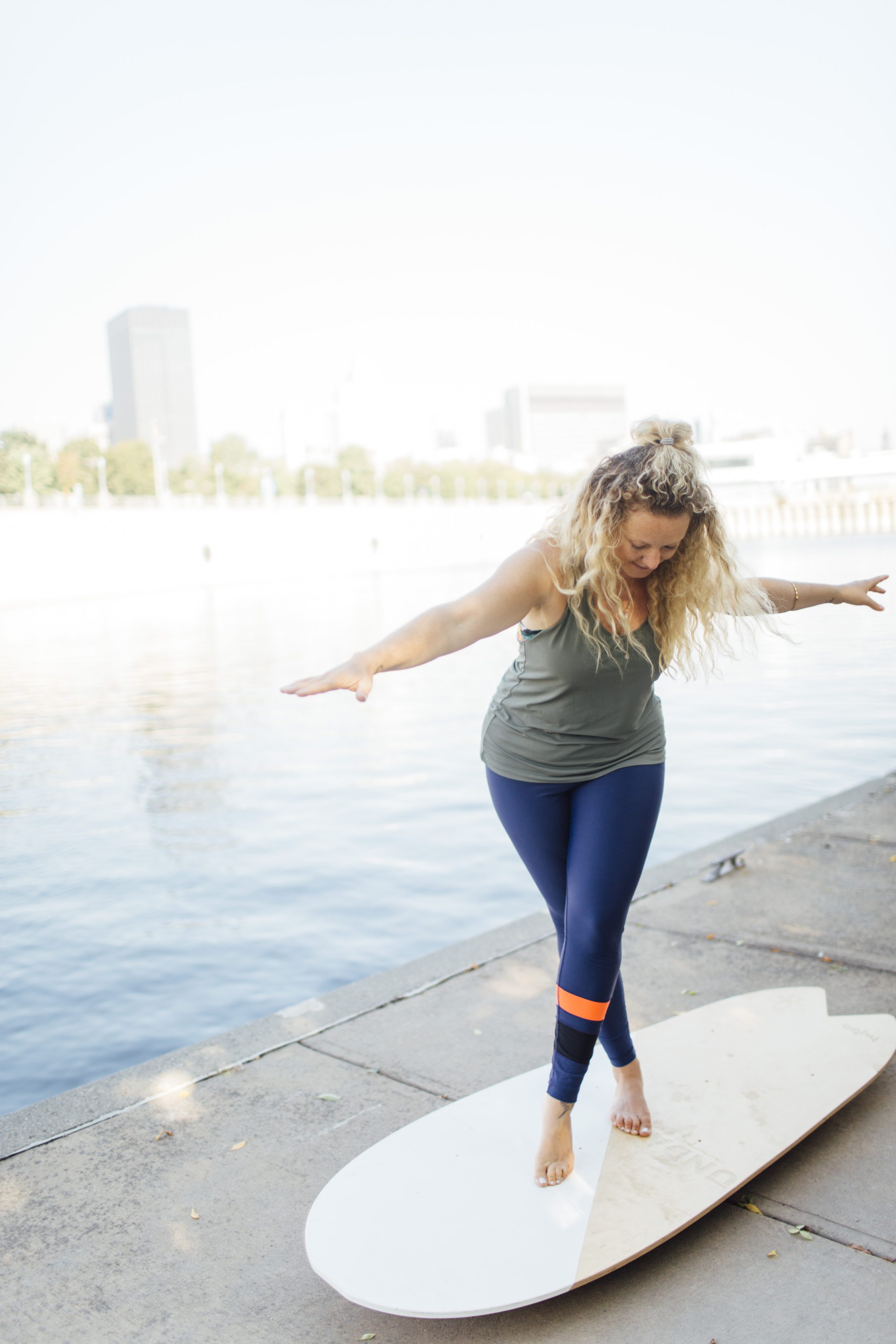 Depuis que j’enseigne le yoga et le SUP Yoga, comme la majorité des professeurs, j’applique le principe du sthira sukha asana enseigné dans les Yoga Sutra de Patanjali. Sthira signifie fermeté, tenue rigoureuse. Sukha signifie agréable, souple et confortable. La pratique du Unda Yoga ne fait pas exception à cet enseignement. Même que je le répète régulièrement lors d’un cours.
À cela, s’ajoute l’aspect mental. Un mental agité donnera beaucoup de fils à retorde à l’équilibre du corps. Tout comme la respiration, si elle est bloquée ou simplement ignorée, l’union du corps et de l’esprit ne pourra faire «un» sur la planche d’équilibre.
Le regard et le focus visuel sont également des aspects non négligeables. Nommée drishti en sanskrit, c’est une technique de contemplation où le yogi concentre son attention et sa vision sur un point. Elle aide à la concentration, donc elle est parfois pratiquée comme une technique de méditation également. Dans la pratique du Unda Yoga, l’utilisation de drishti aidera à maintenir l’équilibre.
À qui s’adresse cette pratique? À toute personne qui souhaite ajouter une nouvelle dimension à sa pratique de yoga existante. Les sportifs confirmés tels que les triathlètes, les professionnels de sports de glisse ou les coureurs pourront explorer de nouvelles sensations et obtenir un excellent complément d’entraînement. Pourquoi? Parce que les facultés d’équilibres (évidemment!) seront mises au défi, la proprioception et le travail des stabilisateurs du haut et du bas du corps sont également très sollicités.
Au final, l’aspect du mouvement de l’eau calme le mental et apaise le corps. Par exemple, je suis convaincue que notre mémoire sensorielle se réveille lorsque nous sommes en balasana (posture de l’enfant) sur une planche UNDA et que ça lui rappel lorsque nous étions un nourrisson doucement bercé ou lorsque nous étions un fœtus vivant dans un milieu amniotique de faible pesanteur.
Ce n’est pas pour rien que les gens qui essaient la planche à pagaie, le SUP Yoga ou le surf en deviennent généralement accros. La fluidité des mouvements du corps procure un sentiment de liberté tout en apportant un aspect créatif et ludique.
Je crois sincèrement que le Unda Yoga a la possibilité d’être une pratique d’ouverture et d’expérimentation pour tout le monde.
Aloha!
Ne manquez pas Marie-ève Bertrand à Expo Yoga 2018!
]]>Quelle pratique de yoga vient te chercher le plus? Explique-la et décris-la nous.
Le Vinyasa, plus particulièrement celui qu’on pratique au studio de yoga Wanderlust où j’enseigne. Ce style est un enchaînement de postures créatives et organiques accompagné de musique. Chaque asana, chaque transition a sa raison d’être, rien n’est laissé au hasard ce qui rend les séquences intelligentes et surprenantes. J’aime cette pratique, car elle me permet d’être pleinement présente et concentrée dans le moment présent.
Quelle personne admires-tu le plus et pourquoi?
Chelsey Korus. Elle a été ma découverte en 2017. En plus d’être une enseignante de yoga authentique et passionnée, elle est aussi un être humain engagé qui a pour mission de faire bouger les choses. J’aime son approche, car elle va au-delà de la pratique physique du yoga, elle prône un style de vie sain et équilibré en pleine conscience.
Quel ingrédient est un incontournable dans ton alimentation?
L’huile de coconut. J’adore cet ingrédient car il est multiusage. Je peux autant l’utiliser pour la cuisson que pour hydrater ma peau et mes cheveux!
Ne manquez pas Eve à Expo Yoga 2018!
Découvrez son atelier.
Enjoy !
What has meditation brought to your life?
Where do I begin! Meditation teaches me to see clearly, things I don’t normally see because I’m distracted, hiding, overlooking them, or running from them. It also gently reminds me how I take so much of this amazing life for granted. Everyday things like the breath or being able to walk are gifts that I tend to forget when I’m wrapped up in my own world. Yet, with sincere practice, I remember that they are indeed precious, and I don’t need to wait for an illness that threatens to take them away to remind me. With the help of meditation, I have also begun to see that the acceptance of who I am in this moment is a radical act of healing that is my birthright, and that no matter how many people tell me they love and accept me and think I am worthy, only I have that capacity to free myself of false beliefs right here in this moment. Meditation has also made me more compassionate, not just to myself but to others, too. In practice, I get to explore the intricate ways joy feels, or confusion, or having a strong opinion. I become so familiar with my experiences that when I’m faced with someone who is full of joy, I remember how it feels and can rejoice with them, or when someone has a strong opinion, I remember the hardening, protecting, controlling qualities, and I soften. Basically, it gives me permission to fully be me, which allows me to let others fully be themselves, too.

What food couldn’t you live without?
My mother’s pancit! Pancit is a traditional Filipino dish made of very thin rice noodles fried with soy sauce some citrus, and some variation of sliced meat and chopped vegetables. Every time I see her and for every holiday, I ask her to make some. Eating it reminds me of family holidays and special occasions, and brings up in me feelings of warmth and love.
In whose body would you like to reincarnate?
The still-living South Korean Buddhist nun, Jeong Kwan. I came to know her through her breathtaking episode on Netflix’s Chef’s Table (season 3, episode 1). Her days seem to be spent in quietude, something I’ve recently committed to with a drastically reduced teaching schedule, and her practice of Buddhism is seamlessly integrated into what she does daily, particularly as the monastery cook. According to her, “There is no difference between cooking and pursuing Buddha’s way.” I deeply admire her ability to see the magic of this practice in something we often take for granted, yet have numerous opportunities daily to revere it like she does – food.
Don’t miss Dawn at Expo Yoga 2018!
]]>Voici une recette hyper nourrissante et gourmande, mais sans la lourdeur habituelle des plats gratinés: une lasagne sans fromage, mais avec du ricotta de tofu et une sauce crémeuse à la courge au goût fromagé! J’ai utilisé des pâtes à base de farine de lentilles, qui sont hyper riches en protéines, sans gluten et sans pré-cuisson, mais n’importe quelle pâte ferait l’affaire (choisissez des grains entiers si vous pouvez!). Il y a plusieurs étapes, et je vous suggère de tout préparer d’avance avant de débuter l’assemblage. Après, le fun commence!
Ingrédients
- 1 paquet (environ 227g) de lasagnes
- 1 bouteille (environ 680g) de coulis de tomates ou de votre sauce tomate préférée
- 1 paquet de tofu ferme ou extra-ferme, minimalement égoutté (vraiment pas nécessaire de le presser!)
- 1 petite courge butternut coupée en morceaux et rôtie (environ 40 minutes à 375 degrés)
- 2 x 1/4 tasse de levure nutritionnelle (levure en flocons qui donne un goût fromagé!)
- 1 cuillère à soupe de moutarde de Dijon
- 1 cuillère à soupe de vinaigre de cidre ou de jus de citron
- 2 x 1/2 tasse d’eau
- 2/3 tasse de kale haché finement et légèrement salé:
- environ 1 tasse de petites tomates tranchées (ou 2-3 tomates italiennes tranchées)
- 1 cuillère à soupe de vinaigre balsamique
- poudre d’ail, au goût
- basilic séché, au goût
- 1/2 tasse de noix de cajou hachées
- sel et poivre

La préparation
Préchauffer le four à 390 degrés.
Pour la ricotta:
Défaire le bloc de tofu en gros morceaux et le mettre au mélangeur ou au robot avec 1/2 tasse d’eau, 1/4 tasse de levure nutritionnelle, 1 cuillère à soupe de vinaigre de cidre, un peu de poudre d’ail et du sel et poivre au goût. Mélanger jusqu’à l’obtention d’une texture de ricotta. Réserver dans un bol et rincer le contenant du mélangeur.
Pour la sauce à la courge:
Mettre les morceaux de courge rôtis dans le mélangeur avec 1/2 tasse d’eau, 1/4 tasse de levure nutritionnelle, 1 cuillère à soupe de moutarde de Dijon, un peu de poudre d’ail et du sel et poivre au goût. Réserver.
Pour la garniture de tomates:
Mélanger les tranches de tomates avec 1 cuillère à soupe de vinaigre balsamique, du basilic séché, du sel et du poivre. Réserver.
Maintenant, la partie amusante débute : l’assemblage!
- Verser la moitié du pot de coulis de tomates au fond du moule à lasagne. Couvrir d’une rangée de pâtes.
- Étendre ensuite la ricotta, puis couvrir d’une seconde rangée de pâtes.
- Étendre la sauce crémeuse à la courge, puis disposer également le kale haché. Couvrir d’une troisième et dernière rangée de pâtes.
- Verser la seconde moitié du coulis et disposer les tomates sur le dessus. Terminer en disposant les noix de cajou hachées.
- Couvrir d’une feuille d’aluminium et cuire durant 45 minutes. Retirer la feuille d’aluminium, et cuire un 5 minutes additionnelles.
La lasagne est prête! Elle sera parfaite servie avec une petite salade verte.
Bon appétit!
Cette recette a été originalement publiée sur le blogue de Pop Spirit.
Ne manquez pas les ateliers de Marie-eve Bertrand à Expo Yoga 2018.
]]>By Melanie Richards, founder and director of HappyTree yoga studio in Montreal.
Ever since I was little, I wanted to be an actress. To me, there was no better feeling in the world than being on stage and expressing myself in front of an audience! Then I grew up, went to university and chose to be behind the scenes with a specialization in television production. All the while, I auditioned for and starred in some of my peers’ productions and my television professor would say to me, “What are you doing behind the camera? You should be in front of the camera!” I still had the acting bug and with these words of encouragement, I continued acting in local plays and productions as a hobby after graduating.

Disheartened with my job search in the communications field, I then mustered the courage to give acting a real shot. I posed for my first professional headshots and started looking for an agent, which was hard because I wasn’t a member of ACTRA, the Canadian acting union. The famous catch 22 was that you needed to be part of the union in order to get a role, however it was near impossible to get a role unless you were already in the union. Finally, an agent reluctantly took me in, though he criticized me for starting out so late in the game. I was twenty-two.
I remember stepping into his office one day to show him my new acting c.v. wearing my most slimming little black dress. I had taken great care in my appearance, hoping to impress him. Instead, he took my resumé in his hands and with tired eyes slowly shifted his gaze between the piece of paper and my body, making me feel increasingly uncomfortable as I stood vulnerably in front of him. With a worn albeit compassionate expression on his face, he asked me bluntly if I had lied about my weight. Actually, I had. I knew at 5’6” that if I wrote down my real weight of 130 lbs. it would negatively affect my chances of getting an audition, so I said I was 125 lbs. I lied again when I told him I hadn’t lied.
My agent remained sceptical. “You have an athletic build”, he said matter-of-factly. “The anorexic look is in and you don’t have it, so you won’t be able to get a leading role. Your best chances will be at playing the supporting role of “the best friend”. There was no malice in his voice; he wasn’t trying to be mean. He was simply telling me the truth about the industry I was so desperately trying to break into.
At the time, I didn’t question the sick industry standard of casting starved-looking women in leading roles. Instead, I felt bad about my own healthy weight and thought anxiously of what I could do to change my appearance. I was already going to the gym almost every day and watching what I ate but when I looked in the mirror all I saw were broad shoulders, bulky arms and a stomach that refused to lie flat no matter how many kilometers I ran on the treadmill or how many carbs I cut out of my diet.
I was further influenced by the large collection of women’s fashion magazines that I devoured cover-to-cover every month. In them, I read that Gwyneth Paltrow, Jennifer Aniston and Madonna were practicing Ashtanga Yoga with great results: long lithe limbs, whittled waists and perky “yoga butts”. I had found my answer.
I started going to hot yoga, hoping the extra benefit of sweating would help me shed water weight. I became obsessed, working my entire schedule around the classes four to six times a week. A spaghetti-strapped sports bra and matching hot-pink booty shorts became my uniform of choice for the oppressively hot, carpeted yoga room. I would analyze my body in the mirror in every pose and weigh myself after every class. A few months later, I started seeing the physical results I had so longed for and I also got a totally unexpected result:
Instead of judging my body and objectifying it, I began to feel my body and become one with it.
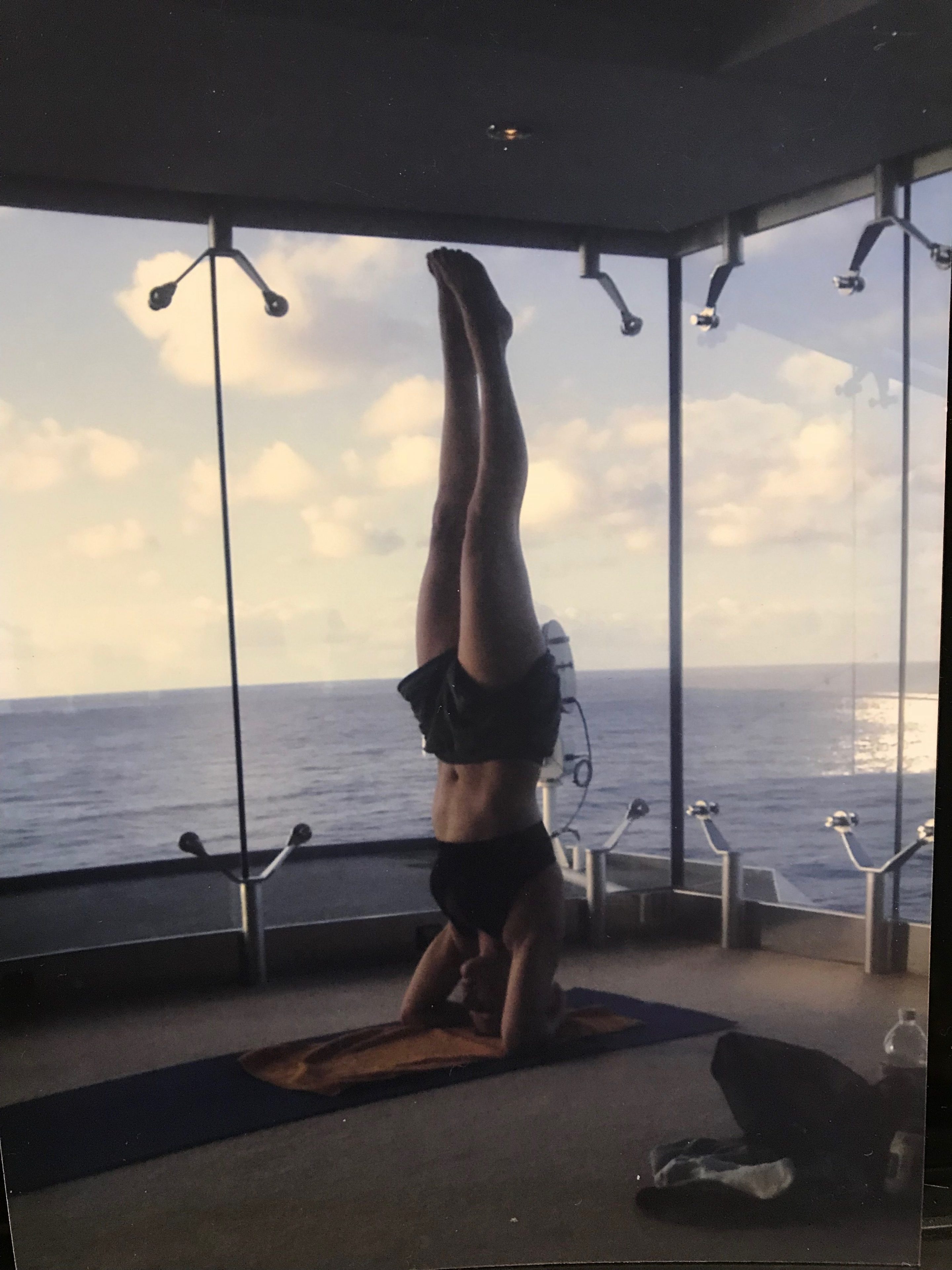
This feeling was new to me – the feeling of being at home in my body, of loving myself just as I was. I became fascinated with this result and went on to join a small studio near my apartment that offered Hatha Yoga and Ashtanga Yoga classes. My practice deepened and so did my confidence. Toward the end of class one afternoon as I lay in final relaxation, tears of relief started rolling gently down my cheeks into my ears and as I made my way back up to seated, I felt like a one hundred pound weight had been lifted from my shoulders. Feeling light as a feather, I floated up to my teacher with a huge grin on my face and said, “I quit”.
I quit acting. Since that day in my agent’s office (and even before that if I’m to be perfectly honest) acting was no longer about expressing myself, it was about proving my worth to an industry that rejected me based on my body’s size and shape; it was about being sexy enough to win the approval of sleazy casting directors; it was about reassuring my fragile ego that I was leading-lady material and that I had value. Yoga brought me back to the deep knowing that my self-worth was independent from my dress size and other people’s opinions of me. In that moment, I felt total freedom and I knew my life’s mission would be to help others realize the same.
Having been in the yoga industry now for almost fifteen years, both as a yoga teacher and studio owner, I can say with absolute certainty that yoga has the power to heal and transform lives, the way it did my own. And with just as much certainty, I can say that the yoga industry is not immune to the same societal pressures and ideals of beauty that run rampant in the film, fashion and beauty industries. Consciously or unconsciously, the pressure is there. It’s real. And it’s all over Instagram.
I know because I feel that pressure, too. A few years ago my spiritual mentor was encouraging me to share my yoga teachings through online videos and I refused because I had recently put on weight. “How selfish of you.” she said. “How selfish of you to deny the world your unique gifts and miss the opportunity to help more people through yoga because you want to lose ten pounds first.” Her words struck me like a gong and reverberated through my entire being. This was exactly the lesson I had learned all those years ago. The lesson that my voice, my value cannot be measured by a scale.
The sophisticated system of Yoga helps our body and mind to become strong, flexible and healthy so that we may have a direct experience of connection to our true nature of joy and compassion, to each other and to our planet. Our body is the vehicle through which our spirit carries out its mission of service in the world – our Dharma. May we remember to make use of our beautiful body for our own good and the good of others, no matter the shape or size.
Don’t miss Melanie at Expo Yoga 2018!
Discover her workshops